how to choose a vibration meter UK beginners
Direct answer: start with jobs, units and access—not brand names
If you are learning how to choose a vibration meter UK beginners should start with the job, the units you need to record, and whether you can place a contact probe on the machine—not with brand names. A vibration meter (also called a vibrometer or vibration analyser in broader guides) measures and evaluates vibration intensity on machinery and in plant environments, typically combining a sensor, data processing and a display. Used as a frontline screening tool for condition monitoring, the right meter helps maintenance teams spot where to focus effort and protect uptime—provided the instrument matches the task.
This guide is for plant and facilities beginners in the UK who want a practical buyer checklist before they buy a handheld machine-vibration meter. It is not about hand-arm vibration (HAVS) meters used for worker exposure assessment.
List assets you will check (motors, fans, generators)
Write down the assets you will actually touch in the first months of use. A clear asset list stops you buying a meter that cannot reach the machines that matter.
- Electric motors on conveyors, pumps and process drives
- Fans and blowers in HVAC or process air systems
- Engines where safe, stable probe contact is possible
- Generators and similar rotating plant
For HVAC, motors, engines and generators, a handheld digital mechanical vibration meter is a common starting point for screening trends. Note access points, guarding and whether a magnetic or handheld probe tip can sit firmly on a solid mounting surface. If you cannot get repeatable contact, readings will be hard to compare week to week—even with a capable instrument.
Decide acceleration / velocity / displacement needs
Vibration meters come in many forms for different applications, standards and regulatory needs; choosing the wrong type for the job can make measurements useless. Before you buy, decide which parameter you need for your screening routine:
- Velocity — widely used for general rotating-machinery condition trends (often quoted in mm/s)
- Acceleration — often more useful when you care about higher-frequency content or early bearing-related screening (confirm what your meter actually supports on the live product page)
- Displacement — sometimes used for low-speed or large-amplitude checks; only include it if your workflow truly needs it
Public listing language for some handheld ranges refers to velocity around 0.01–199.9 mm/s; treat that as a prompt to verify the live product page, not as a guarantee for every SKU. Match units and ranges to the assets on your list, and keep notes so later readings stay comparable.
Probe contact and kit contents to verify on the live product page
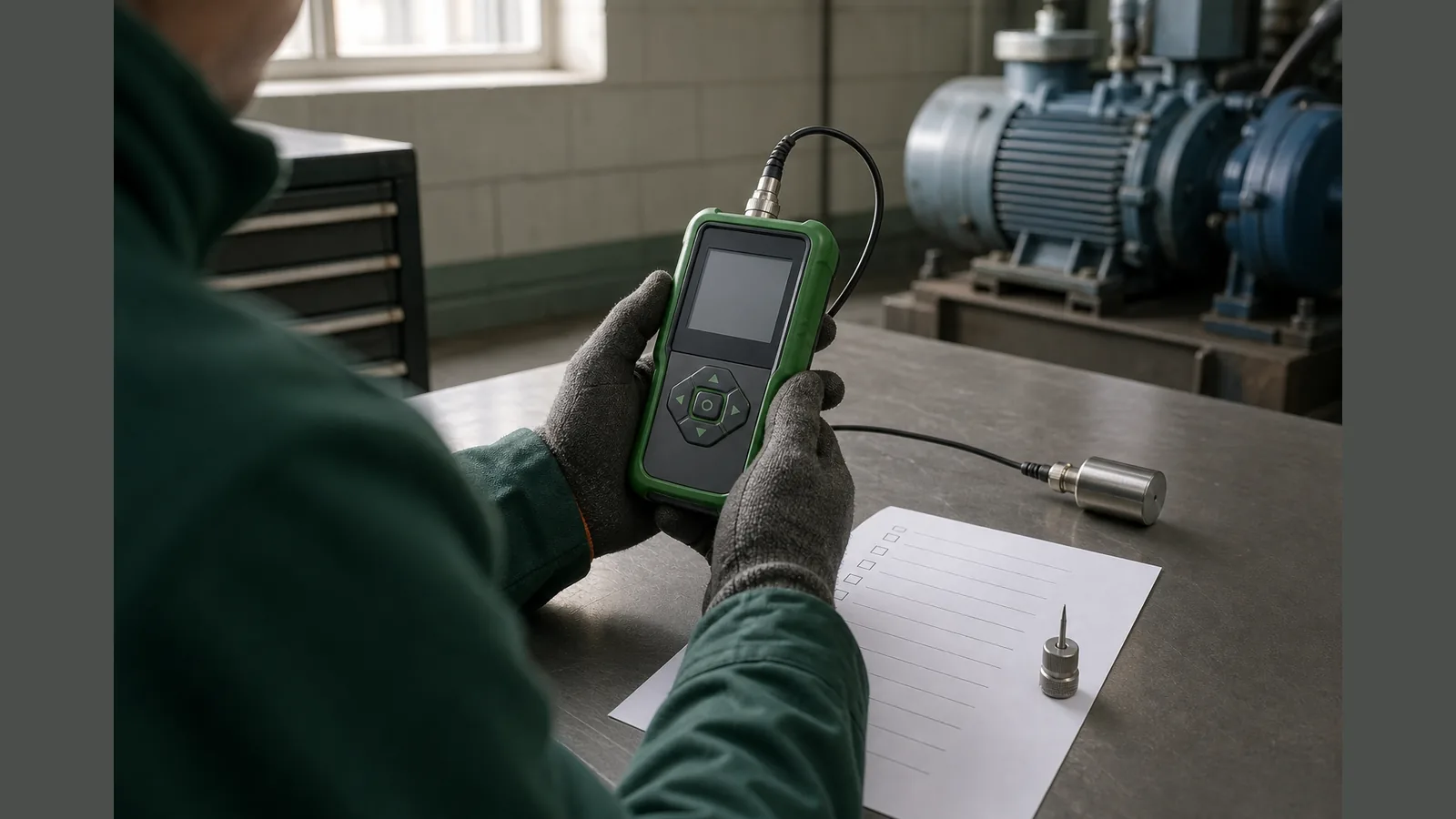
Handheld meters rely on good probe contact. On the live product page, confirm what is in the kit and how contact is made:
- Probe or sensor type and how it couples to the machine
- Any tip, magnet or mounting accessory included
- Display readability for plant lighting
- Whether data can be noted or stored in a way that fits your maintenance log
Internal product positioning describes a Wintact handheld digital mechanical vibration meter aimed at HVAC, motors, engines and generators. Use the current product details page to verify kit contents, displayed units and any stated ranges before you purchase—do not rely on memory of a marketplace listing alone.
Budget vs professional expectations without inventing ISO certification
Budget handheld meters suit beginners who need simple, repeatable screening on accessible plant. Professional analyser kits and certified measurement programmes sit at a different level of cost, training and documentation.
For this shop SKU, no ISO or UKAS certification is asserted. Do not assume a certificate, accredited calibration path or lab-grade accuracy claim unless the live product page states it clearly. If your site, insurer or customer requires certified instrumentation, escalate that requirement separately rather than reading it into a starter handheld meter.
Choosing on budget alone is fine for learning trends; choosing as if the meter were a certified compliance instrument is not—unless the documentation you hold actually says so.
First-use checklist and when to escalate to an analyser
On first use, keep the process boring and repeatable:
- Identify one asset and one fixed measurement point
- Confirm safe isolation or running-state rules for your site
- Seat the probe firmly and record the unit (for example mm/s) with date and machine ID
- Repeat the same point under similar load before comparing numbers
- Flag step-changes or new noise for follow-up—do not treat a single reading as a diagnosis
Escalate from a simple meter to a full vibration analyser (or a specialist) when you need detailed fault diagnosis, frequency spectra you cannot interpret on site, contractual proof of condition, or when the asset is critical and screening alone is not enough. Meters are frontline screening tools; deeper analysis is a different job.
FAQ and next step to Vibmeter Pro
Is a machine vibration meter the same as a HAVS meter?
No. Machine vibration meters screen rotating plant. Hand-arm vibration meters support worker exposure assessment under different methods and regulations. Do not buy one expecting it to do the other’s job.
What should UK beginners check before buying?
Assets you will measure, contact access, which parameter (velocity, acceleration or displacement) you will log, kit contents on the live page, and whether any certification your site requires is actually documented for that SKU.
Where can I see the starter handheld option referenced here?
Review the Vibmeter Pro handheld vibration meter product details to confirm features, kit contents and stated measurement language against your checklist before you buy.