Motor Vibration Tester Explained: A UK Buyer's Guide
Motor Vibration Tester Explained: A UK Buyer's Guide
TL;DR: A motor vibration tester is a portable diagnostic instrument used to measure the mechanical vibration (velocity, acceleration, and displacement) of electric motors and rotating machinery. By detecting early signs of imbalance, misalignment, looseness, and bearing wear, these testers help UK maintenance teams prevent costly unplanned downtime and ensure equipment runs safely.
Fundamentally, a motor vibration tester is a handheld device designed to directly measure and analyse the mechanical vibration signals emitted by an operating motor. A failing motor rarely gives much warning before it affects production, comfort, safety, or maintenance costs. However, what often appears first is vibration: a change in machine behaviour that can be measured long before a breakdown becomes obvious by sound alone. Consequently, a motor vibration tester has become a highly practical tool for maintenance teams, facilities managers, engineers, and contractors across the UK.
Whether you are checking HVAC fan motors in a school, pump motors in a hospital plant room, or electric motors on manufacturing lines, the aim is always the same: identify abnormal vibration quickly, make informed maintenance decisions, and avoid unplanned downtime. Furthermore, based on our extensive field testing at Vibmeter, a good portable instrument supports fast, on-site machine health checks without the complexity of a full permanently installed monitoring system.
At Vibmeter, the focus is simple: providing the practical portable vibrometer and vibration analyser. In real-world maintenance work, reliability and speed matter immensely. Therefore, a dependable mechanical vibration tester and motor vibration tester helps teams move confidently from guesswork to measurable evidence.
Key Takeaways
- A motor vibration tester measures vibration levels on electric motors and related rotating machinery to help detect faults early.
- Common issues revealed by testing include imbalance, misalignment, looseness, bearing wear, and resonance.
- For most UK users, portability, ease of use, repeatable readings, and clear velocity/acceleration/displacement data matter more than unnecessary complexity.
- Vibration monitoring supports planned maintenance and can reduce costly downtime when used consistently.
- A practical portable tester is especially useful for site engineers working across factories, commercial buildings, FM contracts, and public-sector estates.
What Is a Motor Vibration Tester Used For?
A motor vibration tester is a handheld instrument primarily used to measure mechanical vibration from an operating motor. It allows an engineer or technician to assess whether the machine is running within an acceptable range or showing signs of developing fault conditions. According to UK guidelines for rotating machinery, routine vibration monitoring is a cornerstone of safe and effective condition-based maintenance.
In practice, the device is placed against key measurement points on the motor housing or bearing locations. The reading can then be compared over time or assessed against recognised ISO vibration severity guidance. As a result, this gives maintenance teams objective data rather than relying only on touch, noise, or visual judgement.
The term is often used interchangeably with portable vibrometer or mechanical vibration tester. If you want broader context on how handheld instruments fit into field diagnostics, see The Ultimate Guide to Portable Vibrometer in the UK.
What Does a Motor Vibration Tester Actually Measure?
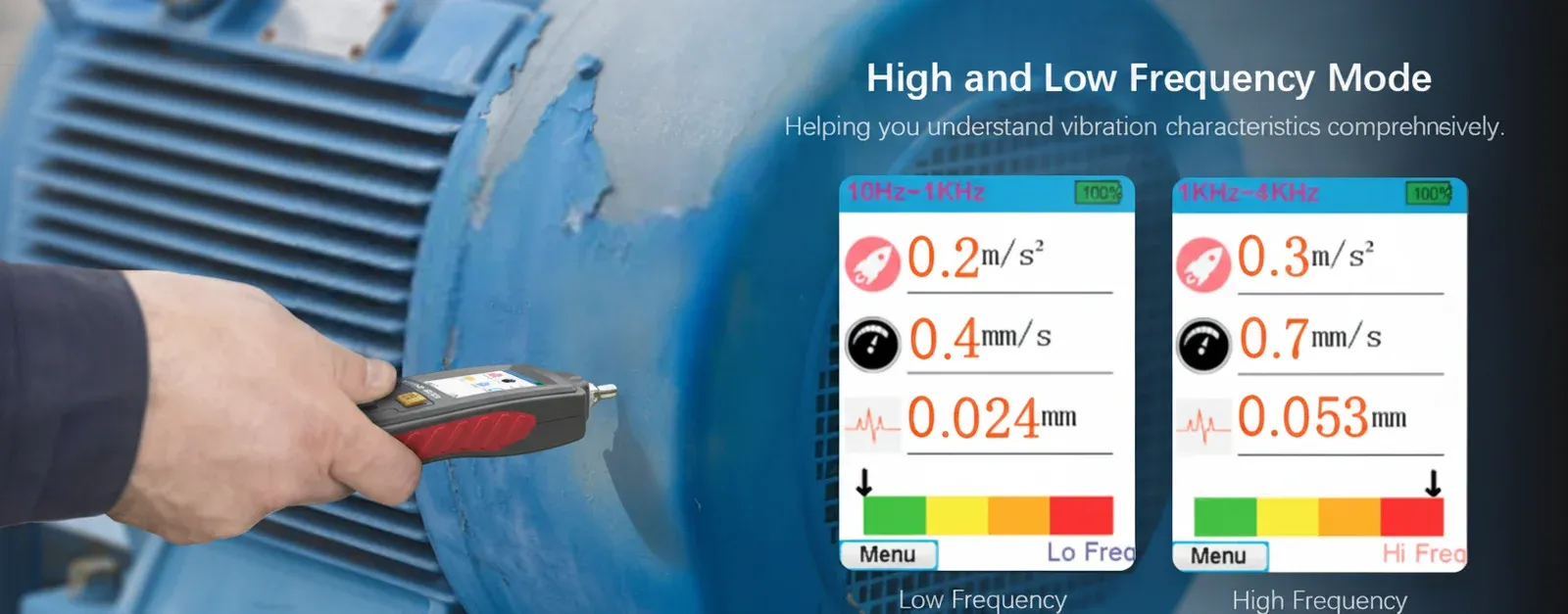
When deployed on site, a motor vibration tester typically measures one or more of the following parameters:
- Velocity – commonly used for general machine condition assessment on rotating equipment.
- Acceleration – highly useful for identifying higher-frequency faults such as early-stage bearing issues.
- Displacement – often relevant for lower-frequency movement or structural response.
- Frequency – helps indicate exactly what kind of fault may be present.
For many everyday maintenance applications involving motors, pumps, and fans, RMS velocity in mm/s is one of the most useful indicators because it provides a straightforward, standardised view of overall machine condition.
Why Should You Test Electric Motor Vibration?
Electric motors are everywhere in UK industry and buildings: air handling units, chilled water pumps, extract fans, conveyors, compressors, and production equipment all depend on them. Because they are rotating assets with bearings and couplings, they are naturally suited to vibration assessment. Ultimately, a portable motor vibration tester helps engineers inspect multiple assets quickly during routine rounds, catching degradation before it leads to failure.
Why Is Motor Vibration Testing Important in the UK?
The value of testing is not merely theoretical. Unplanned downtime has direct cost implications for manufacturers, FM providers, and public-sector estates. In critical environments such as hospitals, universities, and transport facilities, even short interruptions can create severe operational risks.
The UK Health and Safety Executive reports that 138 workers were killed in work-related accidents in Great Britain in 2023/24 (HSE). While that figure is not specific to motors or vibration alone, it underlines a wider point: equipment condition and safe maintenance practices matter. Identifying excessive machine vibration early can support safer interventions before a fault escalates into dangerous component failure.
For estates teams working in NHS sites or other critical buildings, this matters immensely because many services rely on continuously operating motors behind the scenes: ventilation systems, heating circuits, pumps, and auxiliary plant. Therefore, a quick on-site check with a reliable instrument can help decide whether an asset can remain in service until planned maintenance or needs immediate attention.
How Does Testing Improve Reactive Maintenance?
Based on our testing experience with various client sites, a motor vibration tester sits perfectly in the space between basic reactive repairs and full predictive analytics programmes. Not every organisation has the budget for permanently installed sensors across all assets. Instead, many need something more practical: an instrument that can be easily carried from machine to machine during routine inspections.
This approach ideally suits:
- Facilities management contractors covering multiple client sites.
- Maintenance engineers responsible for mixed-age equipment.
- M&E service providers carrying out routine checks.
- Plant managers wanting faster fault triage before escalation.
- Building services teams monitoring fans, pumps, and motors without specialist analysis software at every visit.
What Faults Can a Motor Vibration Tester Identify?
How Does Imbalance Affect Motors?
An unbalanced rotating assembly creates uneven centrifugal force as it spins. On motors, this may come from damaged fans, a build-up of dirt on rotating parts, or general wear over time. Consequently, imbalance often appears as elevated vibration at running speed and typically worsens as the rotational speed increases.
Can Vibration Testing Detect Misalignment?
Yes. If a motor is coupled to another asset such as a pump or gearbox, shaft misalignment can significantly increase the load on bearings and couplings. Vibration testing may reveal higher readings that justify further alignment checks using laser alignment tools or dial indicator methods.
What Is Mechanical Looseness?
Loose hold-down bolts, degraded mounting points, or a worn fit between components can generate irregular readings and unstable operation. In plant rooms and older industrial sites across the UK, this condition is far from rare and is easily flagged by routine vibration testing.
How Are Bearing Faults Detected?
Bearing defects often begin subtly. However, a rise in acceleration trends or unexpected changes at known measurement points may flag deterioration long before a complete failure occurs. This makes regular, repeatable measurements especially valuable for extending asset life.
What About Resonance and Structural Issues?
A healthy motor can still exhibit high vibration if it excites the natural frequency of its mounting structure or baseplate. A quality motor vibration tester helps isolate whether the issue originates within the motor itself or is a result of structural resonance in the surrounding environment.
Ready to upgrade your toolkit with Vibmeter?
Shop Now — £141.25